A dual-rotor permanent magnet induction motor (DRPMIM) is an motor having two rotors within the same motor housing. This rotor arrangement can increase power volume density, efficiency, and reduce cogging torque.[1][2] Some dual-rotor permanent magnet induction motors are a type of induction motors, while others are not actually induction motors.
Stator on the outside
In one arrangement, the motor has an ordinary induction motor stator. A squirrel-cage rotor connected to the output shaft rotates within the stator at slightly less than the rotating field from the stator. Within the squirrel-cage rotor is a freely rotating permanent magnet rotor, which is locked in with rotating field from the stator. The effect of the inner rotor is to reenforce the field from the stator.[1] Because the stator induces current in the rotor, this type of motor meets the definition of an induction motor.
Stator between rotors
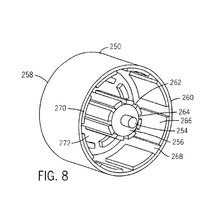
In another arrangement, one rotor is inside the stator with a second rotor on the outside of the stator.[2] The photo labelled FIG. 8 is from a patent application. It shows two rotors assembled into a single unit, with six permanent magnets attached to the outer surface of the inner rotor, and six to the inner surface of the outer rotor.[3] Because the magnets alternate polarity, six surface mounted magnets result in three poles.
Because the stator does not induce current in the rotor, this is not an induction motor, despite the nomenclature.
Applications
Because of their greater power, density dual-rotor permanent magnet induction motors are being considered for use in electric vehicles.
| This article uses material from the Wikipedia article Metasyntactic variable, which is released under the Creative Commons Attribution-ShareAlike 3.0 Unported License. |