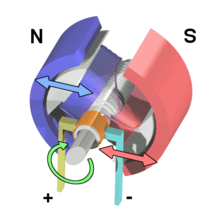
A permanent magnet motor is a type of electric motor that uses permanent magnets in addition to windings on its field, rather than windings only.
Use in electric vehicles
This type of motor is used in the Chevy Bolt,[1] the Chevy Volt, and the Tesla Model 3 rear wheel drive.[2] Recent dual motor Tesla models use a combination of a permanent magnet motor at the back and traditional induction motor at the front.[3]
Permanent magnet motors are more efficient than induction motor or motors with field windings for certain high-efficiency applications such as electric vehicles. Tesla's chief motor designer was quoted discussing these advantages, saying:
Environmental and supply concerns
Permanent magnet motors utilize several types of permanent magnet materials, including hard ferrites, alnico, samarium cobalt and neodymium iron boron. Hard ferrites are the permanent magnet material most commonly found (by weight) in permanent magnet motors. This is due to their low cost. If other factors are important (size, temperature capability, calibration, coercivity, etc.), motor design engineers typically use one of the other permanent magnet materials.
Rare earth production has the consequence of generating waste with elevated radioactivity compared to the natural radioactivity of the ores (waste that is referred to by the US EPA as TENORM, or Technologically Enhanced Naturally Occurring Radioactive Materials). China, the top producer of neodymium, restricted shipments to Japan in 2010 during a controversy over disputed ownership of islands. China imposed strict export quotas on several rare earth metals, saying it wanted to control pollution and preserve resources. The quotas were lifted in 2015. Although neodymium is relatively abundant, global demand for neodymium outstripped production by about 10% in 2017.[3]
| This article uses material from the Wikipedia article Metasyntactic variable, which is released under the Creative Commons Attribution-ShareAlike 3.0 Unported License. |